Modules
Everything outside the core is a module. Modules are compiled in when BareProxy is built, so a binary without a module carries none of its code. Official builds come in two forms: Bare, the core alone, and Full, the core with every module. bareproxy modules lists what a binary contains.
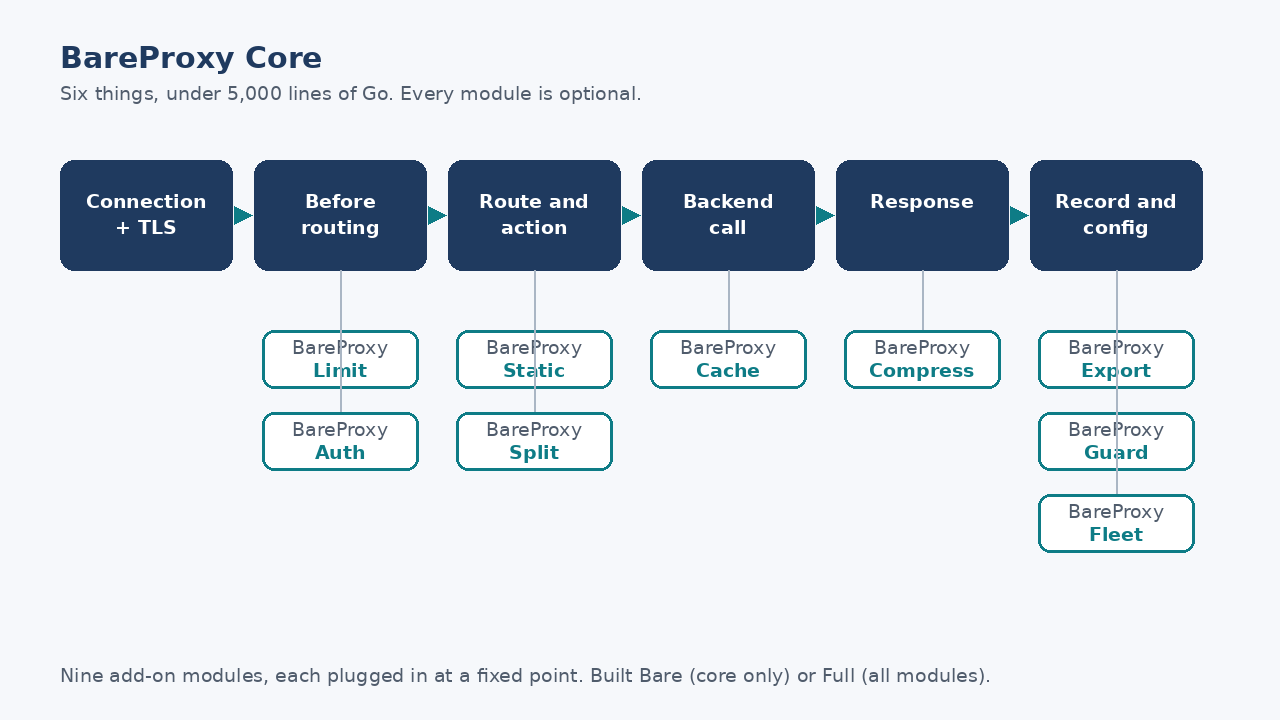
The Nine Modules
| Module | What it adds | Where it plugs in |
|---|---|---|
| BareProxy Static | Files and single-page apps served from a folder, with index files and a fallback to index.html |
A rule’s action |
| BareProxy Compress | gzip and zstd compression, chosen by what the client accepts | The response |
| BareProxy Cache | Responses that say they can be cached, kept in memory or on disk, with purge by path prefix | Around the backend call |
| BareProxy Limit | Request and connection limits per client address, per rule or per site | Before routing |
| BareProxy Auth | API keys, basic auth, or the check handed to an identity service | Before routing |
| BareProxy Split | Weighted and canary splits between pools, by percentage or by header | A rule’s action |
| BareProxy Guard | Watches proxy errors after an apply, and rolls the change back by itself if they jump | Config changes |
| BareProxy Export | Request records sent to OpenTelemetry and log stores | The record |
| BareProxy Fleet | One plan applied across many instances, with shared history and request search | Config changes and records |
Rules Every Module Follows
- The core never depends on a module. Take any module out and the core still builds and passes all of its tests.
- Fixed plug-in points. A module hooks in before routing, as a rule’s action, around the backend call, on the response, on the record or on config changes. It can’t change how the core matches requests.
- The core’s promises still hold. A module’s config lines are checked before they go live.
explainshows what the module did to a request,planreports what a change to its settings affects, and every request it touches still leaves exactly one record. - A budget of its own. Each module stays under 1,500 lines of Go and goes through the same tests as the core.
What Modules Look Like in a Config
Each module adds a few lines of its own. Here Limit and Compress apply to the whole site, Static and Split are rule actions, and Cache sits on a pool:
site example.com
  limit 100/s per client
  compress
  route /assets/* -> static /srv/app/assets
  route /api/* -> api strip
  route /* -> split web 90 web-next 10

pool api
  backend 10.0.0.11:8080
  backend 10.0.0.12:8080
  health /healthz
  cache 5m
The config reference covers the core’s own lines.